01932 847 900 Message us




Sports injuries mostly separate into two categories, trauma and training problems – but an injury can fall into both categories when poor training or overuse leads to a muscle imbalance that ends up causing trauma.
Generally as a result of sudden and direct forces/strains etc. Examples include ligament and other soft-tissue strain or tears such as:
The problems caused by overusing your muscles, incorrect training techniques and training on poor equipment tend to take some time to turn serious. People often say they felt a niggle or a mild ache after their exercise or sporting session, and that this got progressively worse until normal exercise became difficult and the pain lasted longer after the session.
The underlying problem is often a muscle imbalance or bio-mechanical misalignment that you won’t notice in your day-to-day activities. It’s like driving around town and not noticing you have an unbalanced or wobbly wheel. At low speeds, everything seems fine – but when you hit top speed on the motorway, the problem becomes very obvious. Likewise, a small imbalance in how our bodies move can be amplified when we train or exercise.

Another common problem is using the wrong equipment. For instance, the wrong type of running shoe can misalign your foot and leg as you run, which results in joint strain. You may not notice any problems when you are running short distances, but raising your level of exercise when you have a bio-mechanical problem will soon give you an injury.
Poor core stability also causes this type of injury. If you want your movements to be controlled, efficient and sustainable, then you need a stable foundation. Anything less puts your body through unnecessary wear and tear and strain. The stabilising muscles of your trunk should hold you firmly together, aligned correctly, so you can move efficiently and avoid injury.
Unfortunately, with all the time we spend in sedentary postures, our core stabilising muscles are not challenged as much as they should be. This leads to under-activity and weakness.(more about Information Age Syndrome and Muscle Imbalance below)
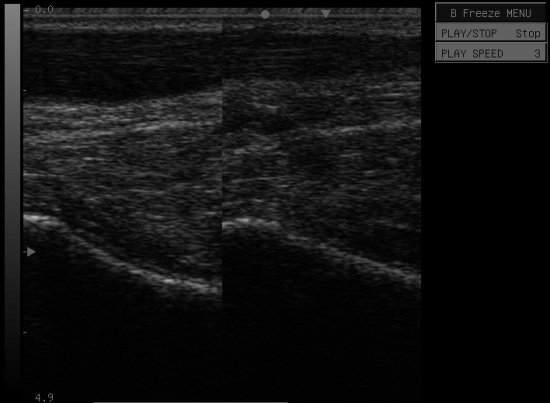 By using real-time ultrasound, we are able to see live images of how certain muscles are working. We mainly use this with patients who have poor core stability as part of their sports specific rehabilitation process. It is not just people with back pain that need to work on their core stability!
I want help with my sports injury











The Weybridge & Walton Physio Therapy team are registered with:

We’re trusted by leading insurers: